
The 2026 World Cup in the USA, Canada and Mexico is approaching fast, and with new kits dropping across the world – including England’s freshly released Nike home and away shirts – it feels like exactly the right moment to settle the debate. Around the Thatsagoal office, we have been arguing about this for weeks. Which World Cup kits are the true all-time greats?
After considerable disagreement, multiple dismissals and at least one strongly worded opinion about Nigeria 1994, here is our definitive ten. We started with five and could not stop there.
Brazil 1970 – The Greatest Kit in Football History

Everything about Brazil at the 1970 World Cup in Mexico was pure class. Pelé, Jairzinho, Rivelino and Tostão played football from another dimension – and they did it in the most iconic kit the sport has ever produced.
The yellow shirt, blue shorts and white socks combination has barely changed in over fifty years because it simply does not need to. It was the first World Cup broadcast in colour television, which meant the world saw that yellow in its full glory for the first time. The timing was perfect. Brazil won their third World Cup and permanently retired the Jules Rimet Trophy. The kit became eternal.
Every yellow Brazil shirt since is measured against this one. None have matched it.
Argentina 1986 – Maradona’s Shirt
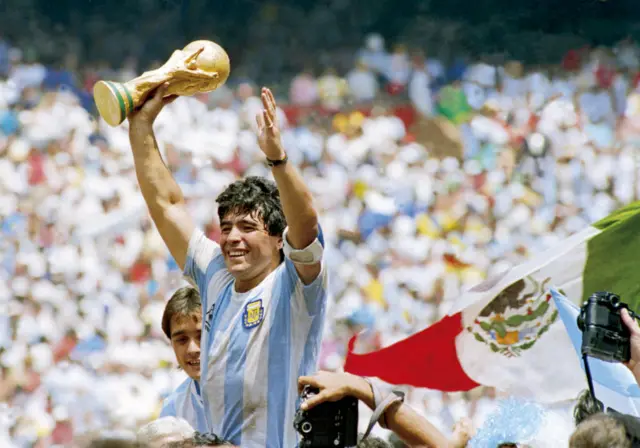
There are football kits. And then there is the shirt Diego Maradona wore when he scored the Hand of God and the Goal of the Century in the same game, within four minutes of each other, against England in the quarter-final of the 1986 World Cup in Mexico.
The Le Coq Sportif design – pale blue and white vertical stripes, clean round collar, the yellow Argentine crest sitting bold on the chest – was a refined version of the Albiceleste’s classic identity. Simple, pure, unmistakable. Maradona wore it on the way to the greatest individual World Cup performance in the tournament’s history, leading Argentina to their second title.
The shirt itself is understated. What happened inside it was anything but.
Germany 1990 – The Christmas Tree That Won the World Cup
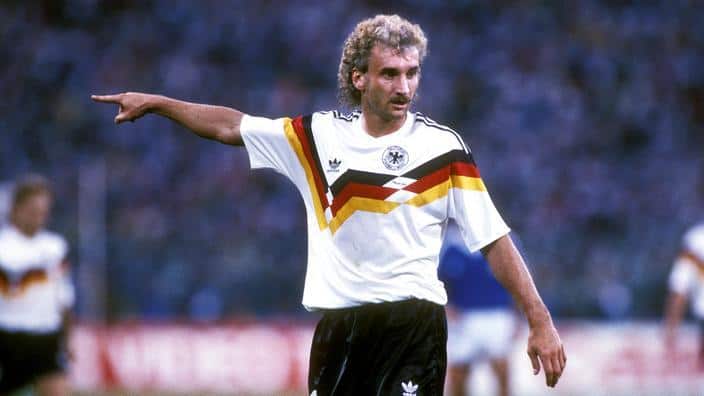
It is with a heavy heart that the West Germany Italia 90 shirt makes any list of the greatest ever, given that it was worn by the side that sent Gazza home in tears in the semi-final. And yet you cannot argue with it.
The adidas design – white base with a graphic mosaic pattern in the national colours of black, red and yellow – was unlike anything produced before. Critics called it a Christmas tree. Germany went on to win the World Cup wearing it anyway. The away shirt, with its distinctive green diagonal graphic pattern, was equally extraordinary.
It set a template for kit design that adidas have returned to repeatedly since. The current German 2026 World Cup kit pays tribute to it. They know what they had.
Italy 1982 – Simplicity as a Masterpiece

Paolo Rossi. Six goals in three knockout games after being left out of the group stage. A Golden Boot, a Ballon d’Or and a World Cup winner’s medal. Italy beat Argentina, Brazil and West Germany to win in Spain, and they did it in a shirt that is a masterclass in doing nothing wrong.
The deep azure blue, the white shorts, the understated stitched badge. No patterns, no gimmicks, no excess. Pure elegance – the kind that makes every overdesigned shirt produced in the decades since look worse by comparison.
Italy 1982 is the gold standard of the simple football shirt done perfectly.
Nigeria 1994 – The Kit That Broke the Internet Before the Internet Existed
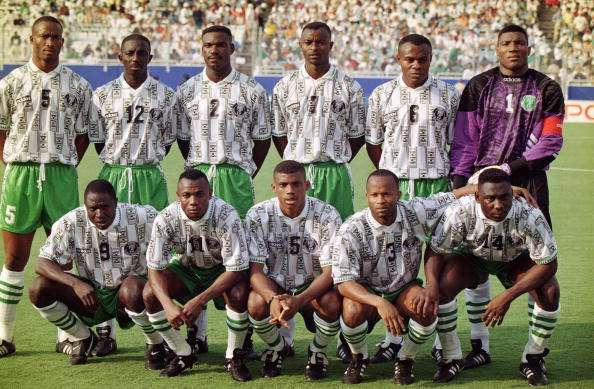
Nigeria’s 1994 World Cup away kit is simultaneously one of the most outrageous and one of the best football shirts ever made. The bright green base with a bold white diagonal sash across the chest looked like nothing else at the tournament. It was the Super Eagles’ first World Cup. They wore this, reached the Round of 16, and made the entire tournament look better.
The kit sold out globally when adidas reissued it in 2018. It has been worn at festivals, photographed for magazines and cited by designers as an influence for three decades. The 2018 Nigeria World Cup kit – which caused queues around stores worldwide – was a direct tribute to this one.
Some shirts become iconic through the football played in them. This one did it on design alone.
France 1998 – Zidane’s Shirt

Zinedine Zidane holding the World Cup aloft at the Stade de France. Two headers in the final. A multi-ethnic French squad winning the tournament on home soil. The image is burned into football history.
The adidas home shirt – deep royal blue with a tricolour striped collar and four horizontal stripes across the chest – is one of the finest the brand has ever produced. Quintessentially 90s in construction, but it holds up beautifully today. France wore it to their first and greatest World Cup triumph.
The shirt became a national symbol. It still is.
Croatia 1998 – Brand New Nation, Instant Classic
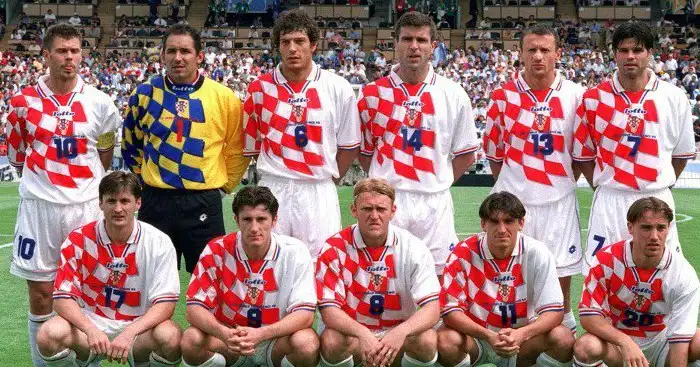
Croatia competed in their first World Cup in 1998 and reached the semi-finals, beating Germany on the way. Davor Šuker won the Golden Boot. They finished third. They did all of it in a kit that had never been seen before.
The Lotto design draped the šahovnica – Croatia’s red and white checkerboard flag pattern – across the shirt itself. Bold, distinctive, immediately recognisable and perfectly suited to a young nation announcing itself to the world. Croatia’s checkerboard has been a World Cup fixture ever since. The 1998 original remains the finest version.
Japan 2014 – The Samurai Blue
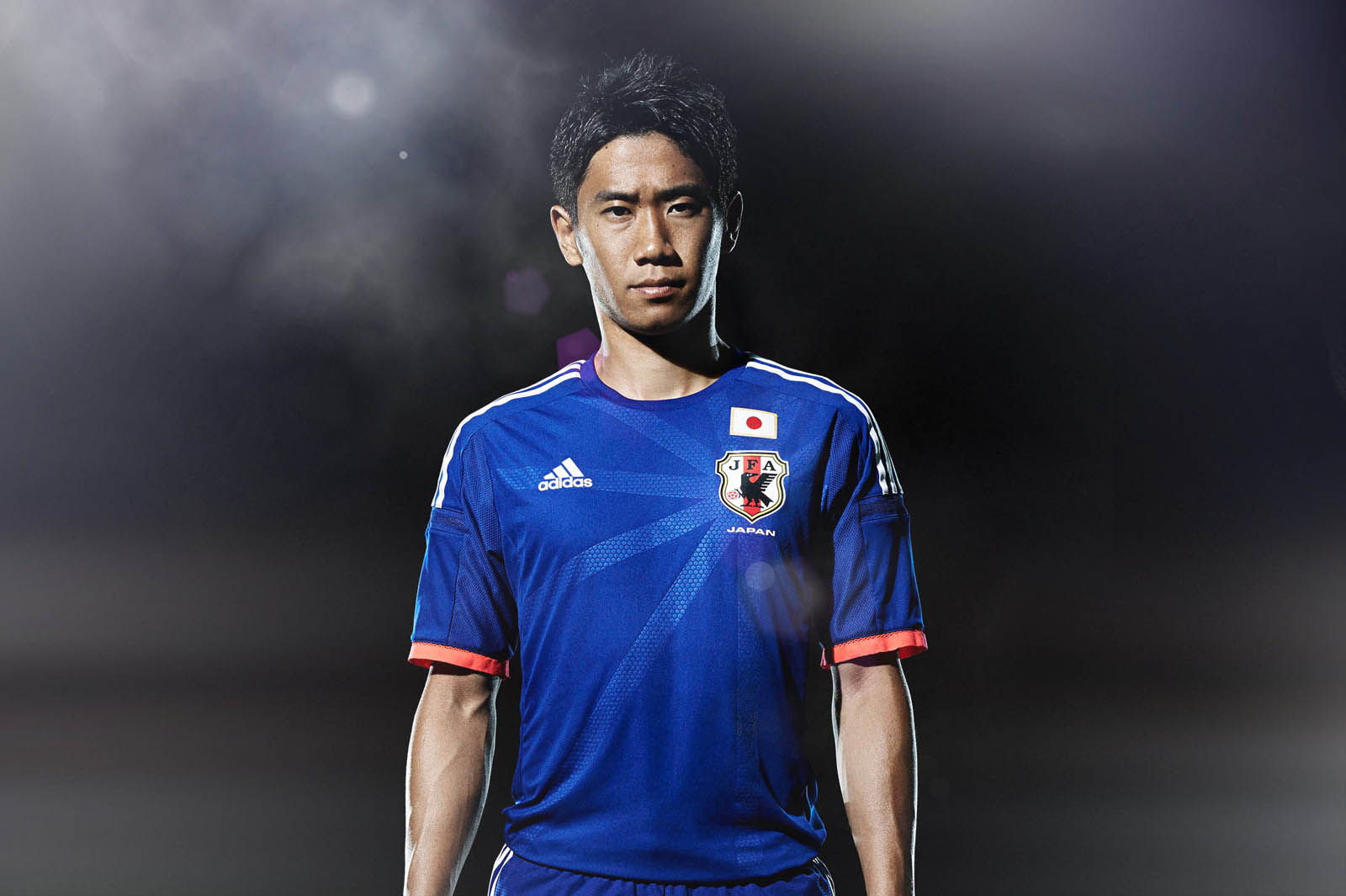
We cannot remember the last Japan kit that was not seriously cool. It was a tough call choosing which edition to include but the 2014 adidas shirt takes it – a rich blue base with a subtle wave pattern woven through the fabric, clean lines and a boldness that reflected the Samurai Blue nickname perfectly.
Japan earned just one point in Brazil. They did it in one of the best kits at the tournament. Some things are unfair.
Peru 1974 – The Red Sash That Never Gets Old

There are a few truly iconic kit designs in world football – Croatia’s checkerboard, Brazil’s yellow, Argentina’s blue and white stripes. Peru’s red sash belongs in that conversation.
The white shirt with its diagonal red stripe running from left shoulder to right hip has been Peru’s identity for decades. The 1974 edition, worn at the World Cup in West Germany, is the definitive version. They reached the quarter-final. The shirt has outlasted the result by half a century.
Peru returns to the World Cup in 2026. The sash is back. Some things should never change.
England 1966 Away – The Red Shirt at the Summit

There is no more iconic image in English football than Bobby Moore lifting the Jules Rimet Trophy at Wembley. The fact that England wore their red away shirt to do it – because West Germany wore white that day – only adds to the legend.
The red shirt, white shorts and red socks of 1966 set a standard that sixty years of football kits have failed to clear. Worn by Moore, Geoff Hurst, Gordon Banks and Martin Peters, it is the shirt against which everything else is measured.
Nike’s 2026 England away kit is red for the same reason. They know exactly what that colour means to this country in a World Cup summer. If England brings it home in 2026, the white home shirt joins the red of ’66 at the very top of this list. That would be something.
England 2026 World Cup Tips & Free Bets
- England World Cup 2026 Tips & Fixtures
- World Cup Free Bets
- World Cup Tips Hub
- Football Tips
- Free Bets Hub
More World Cup Content
bet365 Tournament Challenge World Cup 2026: Free-to-Play Prediction Game Explained
Bet365 Super Boost for Argentina vs Austria – Messi to Score or Assist vs Austria
Portugal vs Congo bet365 Super Boost: 2/1 from 23/20
bet365 Money Back Special for England vs Argentina – Bet Builder Refund if you Lose and £30 Free Bets for New Customers

Andy Clark is a British betting analyst and the founder and editor of Thatsagoal, a UK sports betting comparison site operated by Thatsagoal Media Limited. He has over 20 years of betting experience across football and horse racing, and personally tests every bookmaker account reviewed on the site.